Birch FreeCell
About Birch FreeCell
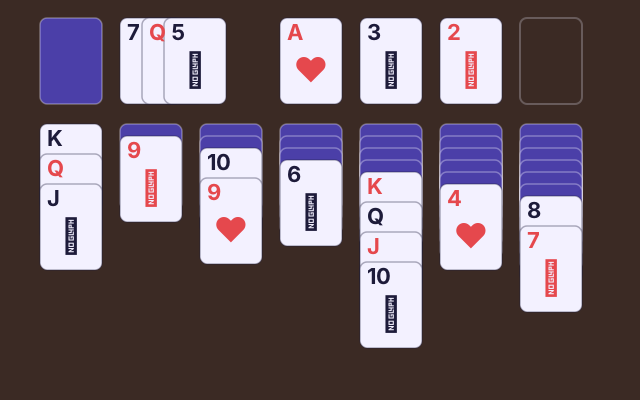
Birch FreeCell is free FreeCell solitaire with 30 levels and a new deal every day. All 52 cards are face up from the start, so every game is a puzzle you can think through. Use four free cells and empty columns to untangle eight columns and build each suit from ace to king. Every deal has been won by a solver.
How to play
- Tap a card to move it, together with any run of cards on top of it. It goes to a foundation if it can, then to a column, then to a free cell. Drag it instead to choose where it goes.
- Build columns down in alternating colours, such as a red 8 on a black 9. Any card or run can go into an empty column.
- Each of the four free cells top left holds one card while you dig out the cards you need.
- Move every card to the four foundations top right, from ace to king in each suit, to win.
FreeCell solitaire rules
FreeCell deals the whole deck face up into eight columns, four of seven cards and four of six. Nothing is hidden and there is no stock, so luck plays almost no part: almost every deal can be won with careful play. A card can move onto a card one rank higher of the opposite colour, onto a foundation, into an empty column or into one of the four free cells. The foundations build up by suit from ace to king, and the game is won when all 52 cards are on them. Birch FreeCell plays a card up to its foundation by itself once no other card could still need it, so you can focus on the hard part.
How many cards you can move at once
Officially FreeCell moves one card at a time, but moving a run through spare free cells and empty columns is so common that the game does it for you. The most cards you can move together is the number of empty free cells plus one, doubled for each empty column. With four empty cells and no empty column you can move five cards. With two empty cells and one empty column you can move six. Moving a run into an empty column counts that column as full, so the limit there is lower. If a tap on a run does nothing and the run shakes, it is too long for the space you have, so free a cell or empty a column first.
How the 30 levels get harder
Every level is a fixed deal, and a solver graded each one by the fewest free cells it needed to win. Levels 1 to 7 can be won using only one free cell, which makes them a gentle way to learn the rules. Levels 8 to 14 need two free cells, levels 15 to 22 need three, and levels 23 to 30 are deals the solver could only win using all four cells. You always have all four cells to play with, so the early levels leave plenty of room for mistakes. The line under the table tells you how many cells the current deal needs.
FreeCell strategy
Look first for the aces and twos and work out what is sitting on top of them. An empty column is worth more than a free cell, because it doubles how many cards you can move, so emptying a short column early is often the best move on the table. Keep free cells empty for as long as you can, and avoid filling the last one unless it leads straight to a better position. Build long runs on kings and queens rather than on low cards, since a run on a low card has to move again later. Before you move a king into an empty column, check that it unlocks something useful.
Daily FreeCell, hints and controls
Birch FreeCell is part of the daily puzzles. Each day brings one new deal, the same for every player, with easier deals early in the week and harder ones toward the weekend. Your first win of the day sets your time for sharing. Hint asks the solver for a winning line from your current position and highlights its first move. If it finds none, your position has probably gone wrong, and Undo or Reset will take you back. Tap a card to send it to the best place, or drag it to pick the spot yourself, such as a free cell when a column would also take it. On a keyboard, Z undoes and H shows a hint.
Added
- Card
- freecell
- solitaire
- daily
- Moames original